
Search Results:
Search Results:
Search Results:
Search Results:
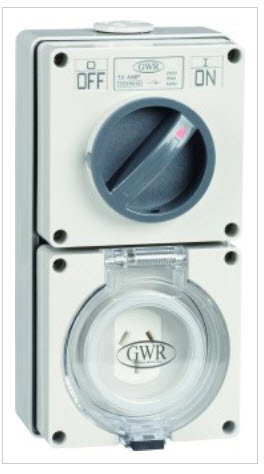
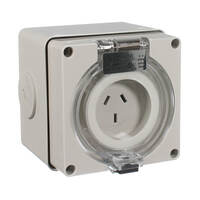
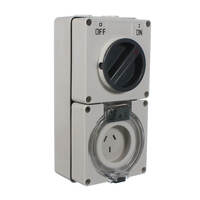
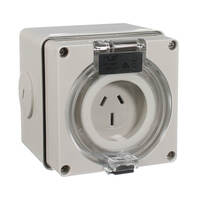
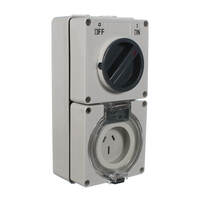
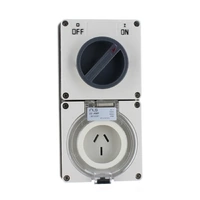
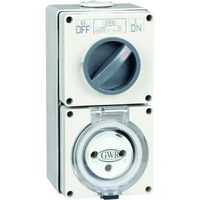
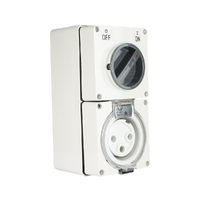
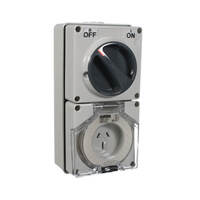
Find the best 3 Pin Industrial Switched Socket Combination Outlets here at Sparky Direct. [ Read More ]
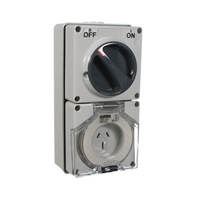
A combination outlet houses a 3 pin socket and a load-rated isolator inside one sealed body. The switch breaks the active and neutral conductors before the user inserts or removes a plug, which protects the contacts from arcing under load. The pin pattern follows AS/NZS 3112 for flat pin units, with round pin variants used for specialist 32A applications.
Australian single-phase supply uses one active conductor at 230V, one neutral, and a separate protective earth. The active carries current to the load, the neutral returns it to the supply, and the earth provides a low-impedance fault path back to the source. A 3 pin outlet keeps these conductors physically separated at the terminals and at the pins, which is critical for safe disconnection under fault.
An integrated switch lets the operator de-energise the socket without unplugging under load. This reduces arc damage to the contacts, extends service life, and lowers risk on wet sites. Many state regulators and safe-work codes require switched outlets in workshop and construction environments, especially where hand-held tools are connected and disconnected throughout the day.
A standard domestic GPO is a flush socket with a small mechanical switch and an IP rating around IP20, suited to dry indoor wall cavities only. A combination outlet is a surface-mounted enclosure with a heavy-duty rotary or rocker switch, a deep gasketed lid, and a sealed pin shroud. The combination outlet is built for exposure to dust, water, oil, and impact, where the domestic GPO would fail within months.
The IP code defined in IEC 60529 specifies an enclosure's protection against solids and liquids, with the first digit covering solids and the second covering liquids. IP66 is the benchmark for outdoor and industrial socket outlets in Australia and across most export markets that share the IEC framework.
The first digit of "6" means the enclosure is dust-tight, with no ingress of dust permitted under standard test conditions. The second digit of "6" means the enclosure resists powerful water jets directed from any angle. Water entering through any seam at the rated test pressure must not damage the equipment.
| IP Rating | Solids | Liquids | Typical Use |
|---|---|---|---|
| IP54 | Limited dust ingress | Splash from any direction | Sheltered indoor or covered outdoor |
| IP65 | Dust-tight | Low-pressure water jets | General outdoor, eaves, garages |
| IP66 | Dust-tight | Powerful water jets | Construction, marine, washdown areas |
IP66 covers the realistic exposures on a working site: pressure washing, heavy rain, direct hose contact, and airborne dust generated by adjacent trades. A drop to IP54 or IP65 may meet code in sheltered locations but it does not survive frequent washdown or persistently dusty conditions. IP66 also provides a margin of safety for long-term performance as gaskets age and lose their original compression set.
Current rating sets the maximum continuous load the outlet can carry without overheating. It must align with both the appliance and the upstream protective device. A 10A flat-pin outlet covers most hand tools, lighting, and small motors. A 15A flat-pin outlet handles welders, larger compressors, and three-phase converters used on workshop benches. The 20A and 32A round-pin outlets are sized for fixed plant and heavier portable equipment.
Flat pin sockets follow the standard Australian configuration up to 15A. Round pin sockets are used at 20A and 32A so that higher-rated plugs cannot be inserted into lower-rated outlets by mistake. This rating-by-shape system is a built-in safeguard: a 32A appliance physically will not fit a 15A socket.
All 3 pin combination outlets sold for the Australian market are rated for 230/240V at 50Hz, matching the local distribution standard. Where three-phase supply is required, the matching product is a 4 pin or 5 pin combination outlet rather than a 3 pin unit. The 3 pin range covers single-phase loads only.
Calculate the appliance's full-load current, add a margin for inrush and duty cycle, and select an outlet rated at or above that figure. Never run a 15A appliance through a 10A outlet, even briefly, because nuisance tripping and contact damage start almost immediately. The outlet, the cable, and the upstream protective device all need to be rated for the load they will see in service.
A polycarbonate enclosure will outlast a low-grade ABS body in direct sun. A captive gasket survives more open-and-close cycles than a glued-in seal that can dislodge after repeated lid opening. Locking handles let a single switch be tagged out for a short maintenance task without removing the supply lead from the entire run.
Start with the equipment nameplate and read off the rated current, voltage, and plug type for every device that will share the circuit. Choose an outlet that meets or exceeds those values, with the correct pin pattern, and that is rated for the working environment. If the equipment list is uncertain, size the outlet to the largest item likely to be connected within the next five years.
Indoor sheltered workshops can run IP54 sockets if the area is reliably dry and free of airborne dust. Outdoor and uncovered locations need IP66 as a minimum. Coastal, food-processing, and washdown environments need IP66 along with stainless fixings and corrosion-resistant terminals to last. Match the IP rating to the worst-case condition, not the average condition.
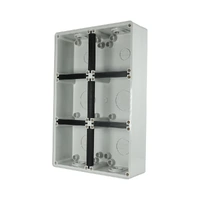
Most combination outlets are surface-mounted with a sealed mounting base, while some accept rear or top conduit entry through a knockout panel. Confirm the entry direction during planning so the cable run does not cross the lid or block the switch handle once installed. Use the correct conduit gland and sealing washer at every entry to maintain the rated IP performance.
The two most common errors are undersized current ratings and mismatched plug shapes, both of which create real safety risk in service. A close third is choosing IP54 or IP65 where IP66 is needed, which leads to early gasket failure and water ingress. Specifying a switch without an integrated isolator on a hand-tool outlet is also a frequent miss on smaller projects.
Site sheds, tool boards, and portable distribution boxes rely on IP66 3 pin combination outlets for tool charging, lighting, and small plant operation. The integrated switch lets each outlet be isolated for safe plug-out without disturbing other circuits on the same board. Lockable models also allow a single circuit to be tagged out at the outlet rather than at the main board, which speeds maintenance work.
Bench grinders, drill presses, compressors, and welders all live on 15A outlets in a typical Australian workshop. Switched combination outlets at each bench let operators kill power to a single workstation without affecting neighbouring stations during fault investigation. Wall-mounted units with rear conduit entry keep cables off the floor and away from foot traffic and trolley wheels.
Dairies, sheds, and pumphouses see a punishing combination of dust, washdown water, hay particles, and animal contact, and IP66 outlets resist all four exposures. The captive lid design also stops insects and dust from entering the socket bore when the outlet is unused for extended periods. RCD-protected models are common in wash bays and milking sheds where wet contact is constant.
Mining sites combine vibration, fine abrasive dust, and heavy machinery moving in close quarters. IP66 outlets with reinforced bodies and locking switches are standard for camp lighting, workshops, and conveyor maintenance points across the industry. Remote and off-grid sites also benefit from outlets that tolerate wide temperature swings between cold nights and very hot days.
Fixed wiring of any 3 pin switched socket combination outlet must be carried out by a licensed electrician under AS/NZS 3000:2018. State-based licensing applies in addition to the national standard. DIY installation of mains-connected outlets is not lawful in any Australian state or territory, and insurance cover is voided for unlicensed work.
Compliance reminder: AS/NZS 3000:2018 requires that all mains-connected outlets be installed, tested, and certified by a licensed electrician. A Certificate of Electrical Safety or equivalent state document must be issued on completion.
Terminate active, neutral, and earth conductors to the labelled terminals according to the manufacturer's wiring diagram. Strip the conductor to the length marked on the body, twist multi-strand cores cleanly, and torque the screw to the manufacturer specification with a calibrated screwdriver. Loose terminations cause heating, arcing, and premature failure of both the outlet and the connected equipment.
The IP rating of a combination outlet is only as good as the weakest sealing point on the entire enclosure. Use a rated gland for every cable entry and plug unused knockouts with the correct sealing plug supplied by the manufacturer. Apply a bead of neutral-cure silicone at the body-to-substrate interface where required, because a skipped gland or unsealed back face breaks the entire rating.
Run continuity, insulation resistance, polarity, and earth fault loop impedance tests before energising the new circuit. Confirm that the switch breaks both active and neutral, and verify RCD operation on RCD-protected models using a calibrated tester. Record all results in the installation certificate and hand a copy to the client for their compliance file.
AS/NZS 3112 covers the configuration and dimensions of single-phase plugs and sockets used in Australia and New Zealand for general-purpose applications. AS/NZS 3123 covers heavy-duty plugs and sockets for industrial use, with stricter mechanical and electrical performance requirements. Together these standards ensure that pin patterns, current ratings, and mechanical fits are uniform across the industry.
AS/NZS 3100 sets the general requirements for electrical equipment approval across the Australian and New Zealand markets. A combination outlet must hold a current approval certificate from a recognised certification scheme. Approval markings should be visible on the body or rating label of every unit supplied.
AS/NZS 3000:2018 is the wiring rules document for Australia and New Zealand and governs cable sizing, protection, earthing, and final sub-circuit design. Every combination outlet installation must satisfy the relevant clauses for the circuit type, the supply arrangement, and the location category.
The Regulatory Compliance Mark, or RCM, identifies that the product complies with applicable Australian electrical safety, EMC, and telecommunications regulations. Look for the RCM tick on the rating label of every outlet before purchase, because products without RCM cannot lawfully be supplied or installed in Australia.
A separate switch and socket arrangement uses two enclosures linked by short conduit. A combination outlet does the same job in one body with fewer joints to seal. The combination outlet has fewer fixings to fail, a smaller footprint on the wall, and is faster to install on a busy site. Maintenance access is also simpler because both functions sit behind a single lid.
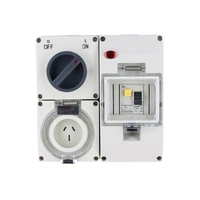
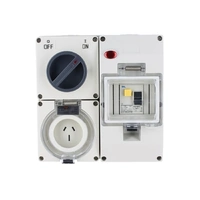
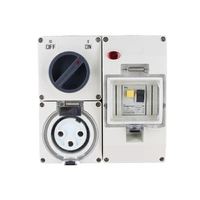
An RCD-protected combination outlet adds a 30mA residual current device inside the enclosure. The RCD trips on earth fault current and disconnects the socket within milliseconds. RCD models are required on construction sites under WHS regulations and are good practice in any wet location. Browse Switched Socket Outlet RCD Protection for current models in stock.
Domestic GPOs are flush-mounted, lightly built, and rated for indoor use behind a finished wall. Industrial combination outlets are surface-mounted, heavy-walled, and rated for direct exposure to weather and dust. The industrial unit costs more, lasts longer in harsh conditions, and meets workplace electrical safety requirements that domestic GPOs simply do not.
Use a domestic GPO inside a finished commercial or residential interior where weather exposure is impossible. Use an IP54 or IP65 outlet under eaves or in sheltered carports where occasional splash is the worst case. Use an IP66 combination outlet outdoors, on industrial sites, in workshops, and anywhere exposed to washdown or airborne dust. The choice flows from the location and not from the budget.
A well-specified IP66 combination outlet typically delivers 10 to 15 years of service in heavy-duty applications when installed and maintained correctly. UV-stabilised polycarbonate resists yellowing and cracking under direct sun, and stainless or corrosion-treated fixings resist seizure in coastal and industrial atmospheres. The lifecycle of a quality outlet usually exceeds the lifecycle of the equipment plugged into it.
An integrated switch lets crews swap plant at the outlet without isolating a whole circuit at the board. That keeps the rest of a workshop or site running during change-outs. For 24/7 operations, that uptime advantage compounds across hundreds of switching events per year and reduces lost production hours.
Inspect the lid gasket, cable glands, and switch action at scheduled intervals set by AS/NZS 3760, which covers in-service inspection and testing of electrical equipment. Inspection intervals are tied to the use environment and should reflect both daily exposure and the criticality of the circuit. A 60-second visual check at each test cycle catches most age-related issues early.
Cheap non-compliant outlets fail in service, and replacement labour usually exceeds the original product cost on the second or third call-out to a problem outlet. A certified IP66 combination outlet costs more upfront and pays back through lower fault rates, fewer repeat visits, and longer working service life across the asset.
These four issues account for most early-life failures in combination outlets:
A 10A outlet on a 15A welder will heat under sustained load and may trip the upstream device repeatedly during normal operation. Over time the contacts pit and the terminals loosen, which compounds the heating problem and accelerates failure. Always size the outlet to the equipment first, then check the cable and protective device match.
An IP66 enclosure with a missing gland is no longer IP66. Water tracks down the cable and into the body within a matter of weeks in wet conditions. The first sign is corrosion at the terminals, followed by a tripped RCD or a fault to earth that takes the circuit out of service. Get the seals right at first install and inspect them at every service interval.
Forcing a 15A flat-pin plug into a 20A round-pin socket is impossible by design, but adapter plugs and home-made fly leads still appear on Australian sites. They bypass the rating-by-shape safeguard and create a real fire risk under load conditions. Refuse and replace any non-standard plug found in service, and document the replacement in your service notes.
Unlicensed installation, missing test results, and outlets without RCM certification all create regulatory and insurance exposure for the building owner and the contractor. None of these shortcuts are worth the risk on a commercial or industrial site, where a single audit failure can shut down work and trigger penalties.
Price varies with current rating, brand, RCD protection, and feature set. The spread between the cheapest and the most heavily specified units is wide. A standard 10A IP66 combination outlet sits at the entry of the range. A 32A RCD-protected outlet from a leading brand sits at the top end. Compare on certification and durability rather than price alone, because the cheapest outlet is rarely the cheapest over the asset's life.
Site contractors fitting out a multi-bay workshop will benefit from buying in carton quantities, with pricing improving at carton level on most lines. Site-wide consistency also makes maintenance and stock-holding easier across the project. Individual unit pricing suits one-off installations and small repair calls.
Imported product without RCM certification is sometimes priced below the floor for compliant goods, which is the first red flag. The risk is twofold: the product may fail prematurely, and the installer carries personal liability for fitting non-compliant equipment to a customer site. Stick with branded, RCM-marked product from reputable wholesalers.
Trade counters offer pickup and same-day stock for urgent jobs, while online wholesalers offer wider range, transparent pricing, and freight to anywhere in Australia. Many electricians use both channels: counter for urgent fills, online for planned work and bulk orders.
For planned work, order early and check stock against the project programme so that critical items are on site before the installation window opens. For urgent jobs, prioritise suppliers who pick and dispatch the same day. Sparky Direct ships nationwide on weekday cut-offs and lists current stock for each item on the product page.
Build the specification from the equipment list and note the current rating, plug type, and environment for every outlet on the project drawing. Where the equipment list is uncertain, default to 15A IP66 for general workshop use and 32A for heavy plant and large compressors. That conservative default covers most edge cases without significantly over-spending on the install.
Confirm the RCM mark, the current rating, the IP rating, and the manufacturer name before placing the order. Check that the supplier holds approval documentation that can be produced on request. Reputable brands include Clipsal, National Light Sources (NLS), Connected Switchgear, 4Cabling, HPM, and PDL.
Order working quantity plus a small buffer of 5 to 10 per cent to cover damaged units, drawing changes, and on-site fitting losses during installation. For long projects, order an additional carton of the most-used rating to hold as maintenance stock once the project hands over to operations.
Sparky Direct stocks the full 3 Pin Switched Socket Combination range alongside related categories such as 3 Pin Angled Plugs, 3 Pin Straight Plugs, 3 Pin Extension Sockets, and 3 Pin Appliance Inlets. For three-phase systems, see the 4 Pin Switched Socket Combinations and 5 Pin IP66 Switched Socket Combinations. The Clipsal 56 Series and Clipsal Easy56 ranges suit projects that standardise on Clipsal switchgear, while lockable safety hardware is stocked under IP66 Key Lockable Isolator Switches.
Club Clipsal is Australia's largest electrician community offering trade rewards, business support, and exclusive benefits. When you nominate Sparky Direct as your preferred wholesaler, we automatically apply your Clipsal spend points to your Club Clipsal account daily.
Entry-level offering coaching, mentoring, and training discounts
Unlock exclusive industry tools and networking events
Access Toyota fleet offers and business software discounts
Maximum benefits, including VIP experiences and rewards
1. Sign Up: Create your Club Clipsal account at clipsal.com/club-clipsal or via the iCat mobile app
2. Nominate Sparky Direct: Select Sparky Direct from the wholesaler dropdown menu in your profile
3. Add Email: Enter your Sparky Direct account email address in the membership number field
4. Start Earning: Every dollar spent on Clipsal products earns points automatically
Redeem points from the rewards store, including gift cards, tools, and experiences. Access business summits, product training, and industry networking events. Receive early access to new product launches and special promotions. Connect with fellow electricians via the Club Clipsal community app.
Watch Clipsal 56C315-GY | 3 Pin 15Amp Switched Socket Outlet IP66 | 56 Series video
Watch NLS 66CV332RCD | 3 Pin 32Amp Switched Socket Outlet Earth leakage Protected IP66 | 30645 video
Watch NLS 66CV320R | 3 Pin 20Amp Switched Socket Outlet IP66 | 30534 video

I looked in a number of locations for a 15amp Weathproof Switched Outlet. I found this one at Sparky Direct at a very competitive price and with a short delivery time enabling me to purchase this outlet and have it installed by an Electrician soon after receiving it. Thanks Sparky Direct.
The Clipsal 15A GPO was delivered the next business day, in perfect condition, in OEM packaging. Can't ask for better service, price or product quality.
This business is great. Easy to navigate website, I ordered one day and received it the next. Well packed and seamless transaction.
Quality products in stock • Fast Australia-wide delivery • Competitive trade pricing
Browse 3 Pin Switched Socket Combinations → Get Expert Advice →Yes. The switch is clearly marked and designed for reliable operation in industrial environments.
3 pin switched socket combination industrial outlets IP66 are available from Sparky Direct, offering access to durable industrial electrical products with Australia-wide delivery.
Delivery availability depends on the supplier and location, with options across metropolitan and regional Australia.
Yes. They are suitable for new installations, upgrades, and replacing existing industrial outlets.
Warranty coverage depends on the manufacturer and supplier, with conditions applying to correct installation and use.
Consider voltage and current rating, IP rating, mounting requirements, and electrician recommendations.
With correct installation and use, they are designed for long service life in harsh conditions.
They generally require minimal maintenance but should be checked during routine electrical inspections.
Yes. They are designed for repeated switching and connection in demanding environments.
Yes. They are often used to supply power to portable tools and fixed equipment.
Yes. They are commonly used in agricultural and rural settings due to their weather resistance.
They have a robust, industrial design that prioritises durability and protection.
Yes. Their IP66 rating makes them suitable for dusty sites, outdoor locations, and wash-down zones.
They are industrial-grade outlets that combine a 3 pin power socket with an integrated on/off switch, designed with IP66 protection against dust and water.
Yes. Being able to turn power off at the socket reduces the risk of accidental operation.
The integrated switch allows power to be isolated at the outlet, improving safety and control during use or maintenance.
Yes. Installation must be carried out by a licensed electrician to ensure safety and compliance.
Most models are surface mounted, making them suitable for exposed industrial installations.
Yes. They are designed to mate with matching 3 pin industrial plugs of the same rating and configuration.
Ratings vary by model and must be selected to suit the electrical supply and connected equipment.
Yes. The IP66 rating makes them suitable for outdoor, wet, and wash-down environments when installed as specified.
They are commonly used in workshops, factories, outdoor installations, agricultural sites, and commercial environments.
Products supplied in Australia are designed to meet relevant AS/NZS electrical and safety standards when installed correctly.
A 3 pin configuration is typically used for single-phase power, including active, neutral, and earth connections.
IP66 means the outlet is fully protected against dust ingress and resistant to powerful water jets, making it suitable for harsh environments.