
Search Results:
Search Results:
Search Results:
Search Results:
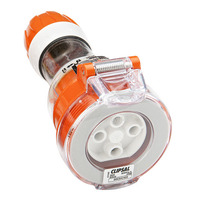
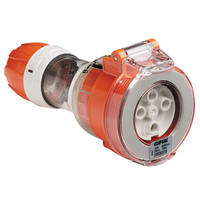
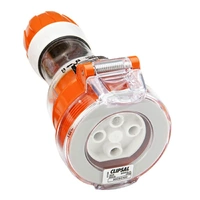
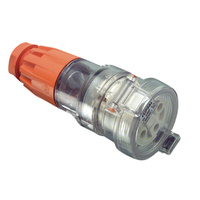
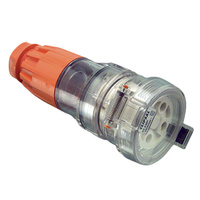
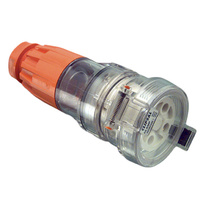
A 4 pin industrial extension socket is a portable female outlet attached to a flexible cable. It accepts a matching 4 pin plug from a power source, then delivers three-phase power plus earth to a downstream load. The four pins carry three active phases (red, white, blue) and a single earth conductor. There is no neutral, so this configuration suits balanced three-phase loads such as motors and welding plant.
The socket body is moulded from impact-resistant polymer with a sealed gland at the cable entry. Internal terminals are crimped or screw-clamped to the conductors. A sealing gasket seats against the matching plug, which keeps moisture and contaminants out of the live contacts.
Three pin industrial sockets carry single-phase power: one active, one neutral, and one earth. They handle resistive loads and small motors up to their rated current. Four pin sockets drop the neutral and carry three actives plus earth, which doubles the available power for the same conductor size on a balanced load.
For most three-phase plant on construction sites, a 4 pin extension is the right choice. Where a neutral is needed (single-phase circuits drawn from a three-phase supply), a 5 pin socket is the correct fit.
Industrial sites distribute power from a switchboard through portable distribution boards (PDBs) and extension leads to the point of use. A 4 pin extension lets a sparky drop a three-phase outlet exactly where the welder, compressor, or pump is positioned. The extension socket terminates the lead and presents a sealed, weatherproof outlet at the work face.
Three-phase motors run more efficiently and start more cleanly than single-phase equivalents at the same kW. Industrial tools, pumps, and HVAC plant are commonly specified as three-phase for that reason. A 4 pin extension socket is the portable interface between fixed three-phase infrastructure and that plant. The IP66 rating means it can sit on wet ground, in rain, or under washdown conditions without compromising safety.
IP66 is defined under AS/NZS 60529. The first digit (6) means the enclosure is dust-tight: no ingress of dust at all. The second digit (6) means it is protected against powerful jets of water from any direction. In practice, a sparky can leave an IP66 socket in driving rain or on a wet slab, and it will keep moisture away from live parts.
Dust ingress is the slow killer of industrial connectors, because fine particulates work into terminations, raise contact resistance, and cause heating at the joint. IP66 housings exclude dust completely when sealed correctly, and the same housing handles water ingress, which causes faster failures such as tracking, short circuits, and earth faults. A jet-rated seal prevents these failures even during high-pressure cleaning.
Lower IP ratings (IP44, IP54) suit covered environments where the socket is shielded from direct weather. IP66 is the right choice for any outdoor use, any washdown area, and any application where the connector may sit on a wet surface. Most Australian construction sites specify IP66 as a baseline for portable three-phase gear.
Even an IP66 socket needs the seal to be intact, because UV exposure degrades polymer over time and rough handling cracks housings. Inspect for visible damage before each use, and replace any unit with a damaged seal, cracked body, or compromised gland.
Industrial extension sockets use thermoplastic bodies engineered for impact, UV, and chemical resistance. The shell colour codes the voltage class: red for 415V three-phase, blue for 240V single-phase, yellow for 110V. A 4 pin socket on the Australian market is almost always red.
The cable gland clamps the outer sheath of the flex. This stops cable movement from transferring force to the terminations. A loose gland is one of the most common causes of socket failure, because flex movement eventually breaks conductors at the screw terminals.
Most 4 pin extension sockets use a screw-on locking ring or a quarter-turn bayonet. The locking ring compresses the sealing gasket against the matching plug. This holds the IP66 rating and stops the plug walking out under cable load.
Quality sockets carry brass contacts, often plated for corrosion resistance, and the contacts grip the plug pins firmly without excessive insertion force. Cheaper units use thinner contacts that loosen after a few hundred cycles, which causes arcing and overheating.
Australian 4 pin industrial sockets are rated 500V, 50Hz, with common current ratings of 10A, 20A, 32A, and 40A. The current rating is the maximum continuous load per phase, while the voltage rating is the maximum line-to-line voltage the insulation will hold.
| Current Rating | Typical Use | Indicative Cable Size |
|---|---|---|
| 10A | Light three-phase tools, small pumps | 1.5mm² flex |
| 20A | Mid-range welders, compressors | 2.5mm² flex |
| 32A | Larger welders, heavier motors | 4mm² flex |
| 40A | Heavy plant, high-current circuits | 6mm² flex |
Cable sizing depends on length, installation method, and load, so the figures above are indicative only. AS/NZS 3008 carries the full sizing tables for Australian conditions.
The socket current rating must equal or exceed the load current. Sizing the socket to the load (rather than to the source breaker) is the safest approach. A 32A socket on a 32A breaker feeding a 28A load is correct. A 20A socket on the same breaker is not, even if the load is only 18A, because a fault current could exceed the socket rating before the breaker trips.
Australian 4 pin sockets follow the IEC 60309 pin layout for 4-pole connectors. The earth pin is offset and larger than the phase pins, which prevents incorrect mating. Phase rotation is fixed by the keyway: phases L1, L2, L3 sit at defined positions around the earth pin.
4 pin extension sockets mate with matching 4 pin plugs of the same current and voltage rating. A 32A socket will not accept a 20A plug, and vice versa: the housings are mechanically keyed by current rating. Always check the plug and socket are from the same family before joining a lead.
Read the equipment nameplate first, since the full-load current and voltage are stamped on the plate. Match the socket current rating to the nameplate value, rounded up to the next standard size: a 14A motor needs a 20A socket, not a 10A one.
Indoor workshops with covered cable runs can use IP44 or IP54 connectors, while outdoor, washdown, and wet-floor environments need IP66. Mine sites, marine, and chemical plants may specify higher IP ratings or hazardous-area certification beyond standard IP66.
Continuous loads should sit at 80 percent of socket rating or below. A 32A socket carrying 32A all day will run hot at the terminations, which accelerates wear on the contacts. Sizing one step up gives headroom for inrush current and ambient heat.
The two most common mistakes are sizing the socket to the breaker (instead of to the load) and ignoring the IP rating for the actual environment. A third common error is mixing brands or current ratings on a single lead, which creates compatibility problems at site.
Construction sites use portable power distribution boards fed from the site supply. A 4 pin extension lead drops three-phase power from the PDB to a welder, concrete mixer, or saw. The IP66 rating handles rain, mud, and surface water without de-rating the connection.
Workshops use 4 pin extensions for portable plant that moves between work cells. A shared three-phase compressor, a portable lathe, or a mobile welder can be repositioned without rewiring fixed outlets. Quality extension sockets handle thousands of mating cycles before service.
Outdoor jobs (irrigation, civil works, event power) need rugged connectors. IP66 4 pin extensions sit on wet ground, in puddles, or under tarps without losing seal integrity. Cable management still matters: keep the socket elevated or supported off sharp ground where possible.
Service crews carry 4 pin extension leads in their van for ad-hoc three-phase jobs such as pump swaps, motor repairs, and temporary lighting on tower setups. A 20A or 32A lead handles most service work, while a 40A unit covers heavier jobs.
Always isolate the source before connecting or disconnecting, because three-phase plug-in under load can draw an arc that damages the contacts. Confirm the source breaker is off, then mate the plug and tighten the locking ring before energising.
Keep the socket clear of standing water if possible, even though IP66 will hold, and elevate the connection on a brick, timber block, or stand. Keep the cable run away from foot and vehicle traffic, then tape down or run cables through covers where they cross paths.
Avoid sharp bends within 100mm of the socket body, because this stresses the conductors at the gland. Use cable hooks or hangers to suspend leads on overhead runs. Inspect the gland and body each time the lead is deployed.
Visual checks before use should cover cracked housings, loose locking rings, damaged pins, and gland integrity. Test and tag intervals are set by the workplace electrical safety procedure, and most sites tag construction leads every 3 months. Industrial environments often run 6 to 12 month intervals.
Industrial connectors sold in Australia must comply with AS/NZS 3123 (plugs and socket-outlets for industrial purposes), and test and tagging on construction sites follows AS/NZS 3012. The wiring rules in AS/NZS 3000:2018 govern the upstream installation, and compliance is the installer's responsibility.
Licensed work only: Termination of 4 pin industrial extension sockets is electrical work under Australian law, and it must be carried out by a licensed electrician. Pre-made leads from a registered manufacturer are the alternative for end users.
The IP66 seal only works when the locking ring is engaged and the gasket is intact. A loose locking ring drops the rating, while a damaged or missing gasket lets water in even when locked. Replace seals during routine service rather than after a failure.
Never exceed the socket current rating, and never bridge a smaller plug into a larger socket with adapters. The mechanical keying on industrial connectors exists to prevent dangerous mismatches: defeating it removes a layer of protection.
Any termination of conductors into a socket body is licensed work. Building a custom lead, replacing a damaged socket on a lead, or repairing a gland are all licensed tasks. Buying a pre-made lead and plugging it in is not. If the lead is opened up, an electrician needs to handle it.
3 pin industrial sockets carry single-phase: 1 active, 1 neutral, 1 earth, which suits single-phase tools and small loads. 4 pin sockets carry three-phase without neutral, ideal for three-phase motors and balanced three-phase loads. Use 3 pin for single-phase, 4 pin for balanced three-phase plant: a 3 pin industrial socket is not interchangeable with a 4 pin unit.
5 pin sockets add a neutral to the four pins. This lets a single connector carry three-phase plus single-phase circuits drawn from one phase and neutral. If the load needs both three-phase and single-phase auxiliary circuits (control gear, fans, lighting), 5 pin extension sockets are the correct choice.
| Connector Type | Phases | Neutral | Best For |
|---|---|---|---|
| 3 Pin | 1 active | Yes | Single-phase tools and loads |
| 4 Pin | 3 active | No | Balanced three-phase motors |
| 5 Pin | 3 active | Yes | Three-phase plus single-phase aux circuits |
Fixed outlets are wall-mounted and serve a defined location. Extension sockets are portable: they sit on the end of a lead and can be moved with the equipment. Most three-phase work needs both: a fixed outlet at the source, and an extension lead to drop power at the work face.
Use 3 pin where the load is single-phase, and use 4 pin where the load is balanced three-phase with no neutral requirement. Use 5 pin where a neutral is needed for control or single-phase auxiliary circuits. Industrial outlets and sockets across all three pin counts are stocked at Sparky Direct.
4 pin IP66 extension sockets perform reliably in rain, dust, and washdown conditions, and the IP66 rating covers most Australian site conditions. Continuous saltwater spray or chemical immersion may need higher IP ratings or specialist connectors.
Connection integrity drops over thousands of mating cycles as contact surfaces wear. Regular inspection catches early signs of arcing (blackening on pin tips, melted plastic around the contact entry). Replace any unit showing these signs before it fails in service.
A failed extension socket stops the job until a replacement is found. Carrying a spare 32A and 20A unit on site keeps work moving. Sites with high three-phase tool usage often keep one of each rating in the lead crib.
Quality 4 pin sockets last for years of daily use, and the cost per cycle is low compared with the downtime cost of a failure. Cheap sockets fail earlier and create more compliance work over their service life.
An undersized socket runs hot, and heat softens the polymer body, distorts the contact terminals, and accelerates failure. The first sign is usually browning around the cable entry, and by that point the socket needs replacement, not repair.
Lower-rated connectors used outdoors will admit water within weeks, with the result being tracking, earth faults, and possible RCD trips that take the whole circuit out of service. Specifying IP66 from the start avoids this entire failure mode.
The mechanical keying on industrial connectors prevents most mismatches, and forcing connections (for instance, with adapters) defeats the safety system. Always carry the matching plug for any extension socket on the lead.
Storing leads coiled around sharp edges fatigues the cable, and dropping sockets on hard ground can crack the housing without visible damage. Coiling leads loosely and storing them off the floor extends service life noticeably.
Prices vary by current rating and brand. NLS units sit at the value end of the trade market, with Clipsal and other premium brands carrying a higher price point for additional engineering features. Sparky Direct stocks both NLS and Clipsal 56 Series 4 pin extension sockets.
Sites running multiple three-phase tools benefit from bulk purchase, and stocking one or two of each common rating (10A, 20A, 32A) covers most jobs. Trade buyers should ask about volume pricing on repeat orders.
Non-compliant imports may carry an IP66 marking without meeting the actual standard. They also commonly use thin polymer bodies that crack on the first hard knock. Sticking to known compliant brands (NLS, Clipsal) avoids the compliance and durability risks.
Online wholesalers compete on price and stock breadth, and Sparky Direct carries the full Australian range across NLS and Clipsal with same-day dispatch on most lines. Trade pricing applies on volume orders.
Most 4 pin extension sockets ship same day from the Brisbane warehouse when ordered before cut-off, and express post covers metro Australia in 1 to 2 business days. Bulk orders are typically held in stock for immediate dispatch.
Start with the equipment nameplate and list the connectors required by current rating. Round up to the next standard size where the nameplate sits between two ratings, and order matching plugs at the same time, because lead build needs both ends.
Carry one spare per common rating on site. A failed connector is a 30-minute swap if the spare is on hand, or a half-day delay if the spare needs to be sourced. The spare cost is small compared with the labour cost of downtime.
Buyers commonly under-order: one socket per circuit, no spares, no margin for damage on site. Order at least one spare per rating in active use. Buyers also commonly mix brands across plugs and sockets on the same lead, which creates fitment issues.
Sparky Direct stocks the Australian range of industrial supplies, including 4 pin extension sockets, matching straight plugs, angled plugs, and switched socket combinations. Trade pricing and same-day dispatch apply on most orders.
Club Clipsal is Australia's largest electrician community offering trade rewards, business support, and exclusive benefits. When you nominate Sparky Direct as your preferred wholesaler, we automatically apply your Clipsal spend points to your Club Clipsal account daily.
Entry-level offering coaching, mentoring, and training discounts
Unlock exclusive industry tools and networking events
Access Toyota fleet offers and business software discounts
Maximum benefits, including VIP experiences and rewards
1. Sign Up: Create your Club Clipsal account at clipsal.com/club-clipsal or via the iCat mobile app
2. Nominate Sparky Direct: Select Sparky Direct from the wholesaler dropdown menu in your profile
3. Add Email: Enter your Sparky Direct account email address in the membership number field
4. Start Earning: Every dollar spent on Clipsal products earns points automatically
Redeem points from the rewards store, including gift cards, tools, and experiences. Access business summits, product training, and industry networking events. Receive early access to new product launches and special promotions. Connect with fellow electricians via the Club Clipsal community app.
Watch NLS 66SCS432 | 4 Pin 32Amp Extension Socket IP66 | 30482 video
Watch NLS 66SCS410 | 4 Pin 10Amp Extension Socket IP66 | 30526 video
Watch NLS 66P432 | 4 Pin 32Amp Straight Plug IP66 | 30474 video

Solid socket, great price. I recommend using these although I can't comment on the long term reliability of this product
Fast Service and great quality product. I ordered this in the afternoon and it was shipped within less than 20 minutes, Australia express post delivered it the next day! Very reliable and will have confidence to use again!
Website was smooth and easy to use. Best pricing for this product compared to competitors and freight was quick. Great quality.
Quality products in stock • Fast Australia-wide delivery • Competitive trade pricing
Browse 4 Pin Extension Sockets → Get Expert Advice →Yes. Their sealed design helps reduce the risk of electrical faults caused by moisture or debris.
4 pin extension socket industrial IP66 products are available from Sparky Direct, offering access to durable industrial electrical connectors with Australia-wide delivery.
Delivery availability depends on the supplier and location, with options across metropolitan and regional Australia.
Yes. They are suitable for new extension leads, upgrades, and replacing worn industrial sockets.
Warranty coverage depends on the manufacturer and supplier, with conditions applying to correct installation and use.
Consider voltage and current rating, IP rating, cable compatibility, and electrician recommendations.
With correct installation and use, they are designed for long service life in harsh conditions.
They generally require minimal maintenance but should be checked during routine electrical inspections.
Yes. They are designed to withstand repeated plugging and unplugging in high-use environments.
Yes. They are often used to supply power to portable or fixed industrial machinery.
Yes. They are commonly used in agricultural and rural environments due to their weather resistance.
They have a robust industrial design that prioritises durability and protection.
Yes. The IP66 rating makes them suitable for wash-down zones and dusty industrial sites.
A 4 pin extension socket industrial IP66 is a heavy-duty socket designed to be fitted to the end of an extension lead, providing a protected industrial power connection.
Yes. They are designed for secure yet straightforward connection and disconnection by trained personnel.
It provides reliable protection against dust, water, and physical damage in demanding work conditions.
Yes. Termination and wiring must be carried out by a licensed electrician to ensure safety and compliance.
Yes. They are specifically designed to be fitted to extension leads for portable industrial power distribution.
Yes. They are designed to mate with matching 4 pin industrial plugs of the same rating and configuration.
Ratings vary by model and must be selected to suit the connected equipment and electrical system requirements.
Yes. The IP66 rating makes them suitable for outdoor and wash-down environments when used as specified.
They are commonly used on worksites, in factories, workshops, agricultural environments, and outdoor industrial locations.
Products supplied in Australia are designed to meet relevant AS/NZS electrical and safety standards when installed correctly.
A 4 pin configuration is typically used for three-phase power with an earth connection in industrial electrical systems.
IP66 means the socket is fully protected against dust ingress and resistant to powerful water jets, making it suitable for harsh environments.