
Search Results:
Search Results:
Search Results:
Search Results:
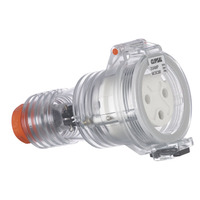
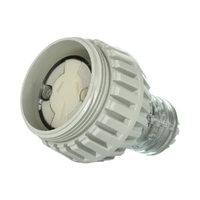
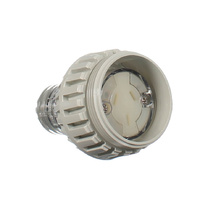
Find the best 3-pin industrial extension sockets here at Sparky Direct. [ Read More ]
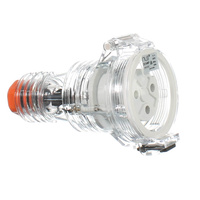
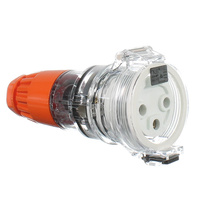
A 3 pin industrial extension socket is the female end of a portable lead designed for single-phase 240V power. The body is moulded from impact-resistant polymer with a captive screw cap that seals against a matching plug. The three pins carry active, neutral, and earth, supporting standard Australian single-phase appliances and tools.
Unlike a household extension lead, the industrial version uses a screw-locking interface and a fully sealed housing. This keeps water, dust, and grit out of the contacts even on a wet construction site or in a wash-down area.
The active pin carries the supply current to the connected load. The neutral pin returns the current to the supply transformer. The earth pin provides a fault path back to the switchboard, allowing the protective device to trip if a live conductor contacts the appliance frame.
Correct earthing is critical on industrial sites where damp conditions and conductive surfaces increase shock risk. A 3 pin IP66 socket maintains earth continuity through the screw-locked connection, so the path to earth stays intact under vibration and pull.
Standard 3-pin extension leads use exposed plug-and-socket connections that admit moisture and dirt. On a worksite, that exposure leads to corrosion, tracking, and earth-loop failures. An IP66 socket seals the connection, holds the plug under load, and survives being dragged across concrete or left in the rain overnight.
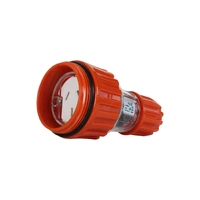
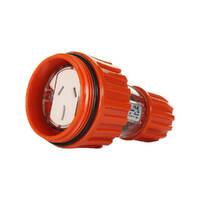
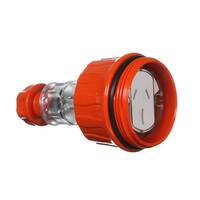
The orange housing on Clipsal 56 Series sockets also provides high visual contrast, reducing the risk of a vehicle, ladder, or trolley crushing the connection in a busy work area.
Domestic 3-pin sockets meet AS/NZS 3112 and rely on friction to retain the plug. Industrial 3-pin sockets meet AS/NZS 3123 and use a threaded coupling ring that mechanically locks the plug into the body. The industrial version is rated for higher cycle counts, harsher environments, and greater pull-out forces.
IP66 is defined under IEC 60529. The first digit (6) indicates total dust-tight protection with no ingress of particles. The second digit (6) indicates protection against powerful water jets from any direction, tested at 100 litres per minute from a 12.5 mm nozzle.
Dust-tight sealing relies on a continuous gasket between the housing halves and a sealing washer where the cable enters the body. Water-jet protection requires the same sealing plus a captive cap that closes the socket face when no plug is inserted.
If the cap is left open or the cable gland is loose, the IP rating no longer applies. Sealing is only valid when every entry point is closed and torqued correctly.
| Rating | Dust Protection | Water Protection | Typical Application |
|---|---|---|---|
| IP54 | Limited dust | Splashing water | Sheltered outdoor, light industrial |
| IP55 | Limited dust | Low-pressure water jets | General industrial, exposed indoor |
| IP66 | Dust-tight | Powerful water jets | Construction, marine, wash-down areas |
IP66 covers jets, not immersion. A socket dropped into a puddle and submerged is outside the rating, and water can enter under pressure or through the cable entry over time. For permanent submerged use, an IP67 or IP68 product is required.
IP66 also says nothing about UV resistance, impact rating, or chemical exposure. Those are separate properties and need to be confirmed against the manufacturer datasheet.
Common 3 pin industrial extension sockets are rated 10A, 15A, 20A, or 32A. The current rating must match the upstream circuit protection and the cable feeding the lead. A 15A socket fitted to a 10A lead is a fire risk, because the cable will overheat before the breaker trips.
Australian single-phase supply is 230V nominal, with most equipment labelled 240V. All standard 3 pin industrial sockets are rated 250V to cover the full supply tolerance. The voltage rating refers to the maximum continuous line-to-earth voltage the insulation can withstand.
A 3 pin IP66 extension socket only mates with a matching 3 pin IP66 plug of the same current rating. The pin spacing, pin diameter, and locking ring thread differ between 10A, 15A, 20A, and 32A configurations. A 10A plug will not fit a 15A socket, which is a deliberate safety feature, not a design flaw.
Pair the extension socket with a matching 3 pin straight plug or 3 pin angled plug at the supply end of the lead.
Check the appliance nameplate for full-load current. Add a margin of at least 25% if the equipment runs continuously. Choose a socket and lead rated above this figure, then size the upstream protective device accordingly.
Clipsal 56 Series sockets use glass-reinforced polymer rated for impact and high temperature. NLS 66SCS sockets use a similar engineered polymer. Both bodies are colour-stable and resist cracking under repeated mechanical stress.
Outdoor sockets are exposed to ultraviolet light, which degrades unstabilised plastics. Quality 56 Series and NLS housings include UV stabiliser to prevent embrittlement over years of sun exposure. Impact resistance is typically rated IK08 or higher, meaning the housing survives a 5 joule strike.
Chemical resistance varies by polymer. Brief contact with diesel, mineral oil, or detergent is normally tolerated. Continuous contact with strong solvents or acids needs confirmation against the manufacturer datasheet.
The cable enters the socket body through a moulded gland or compression fitting. The gland must match the cable outer diameter to compress the seal evenly. An oversized gland leaks. An undersized gland damages the cable insulation.
A correctly selected and installed industrial socket runs for years in outdoor and washdown environments. The failure points are usually the cable gland, the captive cap O-ring, and the locking ring thread. All three are inspectable, and replacement seals are available for most 56 Series models.
For a switched outlet rather than a plain extension socket, see the 3 pin switched socket combination range. For appliance-mounted versions, see the 3 pin appliance inlets.
Builders, electricians, and trade contractors use 3 pin IP66 leads to run power tools from the site distribution board. The screw-locked plug stays connected even when the lead is dragged or stepped on, reducing nuisance trips and unplanned shutdowns.
Workshops use IP66 extension sockets to power benches, welders, dust extractors, and battery chargers. The sealed body resists swarf, coolant mist, and grinding dust. The orange colour of the Clipsal 56 Series stays visible even under workshop grime.
Warehouse loading docks, vehicle service bays, and outdoor compounds use IP66 sockets for floor scrubbers, pressure washers, and trickle chargers. The sockets handle frequent connection and disconnection without contact wear.
Event riggers and outdoor venues use IP66 extension sockets for stage power, food trucks, market stalls, and temporary lighting. The captive cap closes when the socket is unused, keeping rain and debris out between events.
Cable size must suit the socket current rating and the lead length. A 15A lead under 25 metres typically uses 1.5 mm² flexible cable. A 32A lead may require 4 mm² or larger. Voltage drop rises with length, so longer leads need a larger conductor to keep voltage at the tool within tolerance.
Inspect the captive cap O-ring and the cable gland seal at every test-and-tag interval. Replace any seal that shows compression set, cracking, or loss of elasticity. Hand-tighten the locking ring after every connection to maintain the seal under the captive cap.
Coiled leads carrying high current build heat because the cable cannot dissipate. Always uncoil a lead fully before drawing rated current. If the housing or cable feels warm to the touch under load, the lead is undersized for the application and must be replaced.
Test and tag intervals follow AS/NZS 3760 for in-service safety inspection of electrical equipment. On construction sites, AS/NZS 3012 sets shorter intervals because of the harsher conditions. Visual inspection covers the housing, cable, gland, pins, and locking ring before each use.
3 pin industrial sockets are designed and tested to AS/NZS 3123. Installation is governed by AS/NZS 3000:2018, the Wiring Rules. Construction site supply is additionally covered by AS/NZS 3012. In-service testing follows AS/NZS 3760.
The earth pin must be continuous from the supply through the lead to the appliance frame. A break in the earth path leaves exposed metal at appliance voltage if a fault occurs. Earth continuity is the first item checked on every test-and-tag inspection.
The IP66 rating only holds when the captive cap is closed on unused sockets, the cable gland is correctly sized and torqued, and the locking ring is tightened on connected plugs. Any one of these missed reduces the protection class.
In Australia, fixed wiring and the connection of cables into industrial plugs and sockets are restricted electrical work. A licensed electrician must terminate the lead, verify earth continuity, and complete the AS/NZS 3000 test sequence before the lead is placed in service.
3 pin sockets carry single-phase 240V supply: active, neutral, earth. 4 pin sockets carry three-phase 415V without neutral: three actives plus earth. The two systems are not interchangeable, and the pin patterns deliberately prevent cross-connection.
Single-phase 3 pin leads typically run loads up to 32A. Three-phase loads such as large compressors, welders, and motors generally use 4 pin or 5 pin sockets to deliver the required power within reasonable cable size.
3 pin installation requires correct identification of active and neutral. 4 pin installation requires correct phase rotation, because reversing two phases reverses motor direction. Both require verified earth continuity before energising.
Single-phase tools, lighting, and small loads use 3 pin. Three-phase machinery and high-power loads use 4 pin extension sockets. Five-pin sockets carry three-phase supply with neutral, which is needed for some welders and distribution panels. See the 5 pin extension socket range for those applications.
Most common failure: Fitting an oversized cable gland that cannot grip the cable jacket. Water travels along the cable into the housing and tracks across the terminals. The lead may pass an initial test but fail months later under load.
A 10A socket on a 15A lead is the most frequent oversight. The connection looks identical, the appliance runs, but the smaller socket overheats under sustained load and can ignite the housing.
Skipping the captive cap, leaving the locking ring loose, and reusing a damaged O-ring all break the IP66 seal. Once water enters, corrosion of the contacts begins immediately and cannot be reversed.
Forcing a 15A plug into a 20A socket using a non-standard adaptor is a serious safety breach. The over-current protection is then incorrectly matched to the lead, removing the protection the rating system is designed to provide.
Cutting back the cable jacket too far inside the gland leaves bare conductor exposed to flexing. Crimping rather than terminating the conductors under the screw terminal can also fail under repeated thermal cycling. Both faults are picked up on a careful AS/NZS 3000 test sequence.
Pricing varies by current rating, brand, and pack quantity. 10A and 15A units sit at the lower end of the range. 32A units cost more because of the heavier contact assembly and larger housing. Buying through a wholesale account such as Sparky Direct gives trade pricing below RRP.
Contractors who fit out site sheds, hire fleets, or maintenance vans benefit from carton pricing. Single units cover one-off repairs and replacement work. Sparky Direct holds stock in both formats.
Uncertified imports may look identical to a Clipsal 56 Series socket but lack the materials, sealing, and test certification. Failure modes include UV cracking within months, gland slippage, and contact degradation. The cost of a callback to replace a failed lead far exceeds the saving on the original purchase.
Local trade counters offer face-to-face advice and immediate stock. Online wholesalers offer broader range, better pricing, and direct delivery to site. Sparky Direct combines wholesale pricing with same-day dispatch from Australian stock.
Stocked items dispatch from the Sparky Direct warehouse the same business day on orders placed before the cut-off. Major couriers reach metro areas next business day and most regional areas within two to three business days.
Confirm the load current, supply phase, and site environment before ordering. Match the socket rating to the cable rating and the upstream protective device. Allow at least one spare per common size on a working van.
Check that each product page shows the AS/NZS 3123 compliance statement and a valid manufacturer part number. Reject any product without these markings, regardless of price.
For a fit-out, count the lead-make-up requirement plus 10 to 15 percent for breakage and rework. For maintenance stock, hold at least one of every current rating used on site, plus replacement seal kits for the most common models.
Sparky Direct stocks the Clipsal 56 Series orange range, the Easy56 prewired range, and the NLS 66SCS series. Browse the full IP66 3 pin industrial outlets and sockets category for switched outlets, plugs, and matched accessories. Related industrial categories include IP66 key lockable isolator switches and the broader industrial outlets range.
Brand pages: Clipsal, Clipsal Easy56, and National Light Sources.
Club Clipsal is Australia's largest electrician community offering trade rewards, business support, and exclusive benefits. When you nominate Sparky Direct as your preferred wholesaler, we automatically apply your Clipsal spend points to your Club Clipsal account daily.
Entry-level offering coaching, mentoring, and training discounts
Unlock exclusive industry tools and networking events
Access Toyota fleet offers and business software discounts
Maximum benefits, including VIP experiences and rewards
1. Sign Up: Create your Club Clipsal account at clipsal.com/club-clipsal or via the iCat mobile app
2. Nominate Sparky Direct: Select Sparky Direct from the wholesaler dropdown menu in your profile
3. Add Email: Enter your Sparky Direct account email address in the membership number field
4. Start Earning: Every dollar spent on Clipsal products earns points automatically
Redeem points from the rewards store, including gift cards, tools, and experiences. Access business summits, product training, and industry networking events. Receive early access to new product launches and special promotions. Connect with fellow electricians via the Club Clipsal community app.
Watch CLIPSAL 56CSC315-EO | Extension Socket 3 Flat Pin 15Amp IP66 | 56 series Orange video
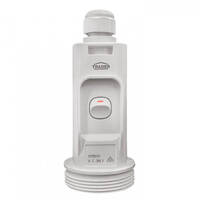
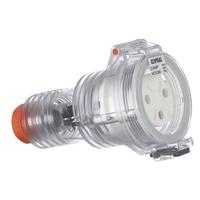
Watch NLS 66SCS310F | 3 Pin 10Amp Extension Socket IP66 | 30498 video
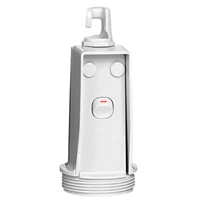
Watch NLS 66SCS332 | 3 Round Pin 32Amp Extension Socket IP66 | 30525 video

It was used to connect power to a yacht. It is waterproof as it screws in to the male fitting with an O ring in place. It is easy to use.
Brilliant piece of kit. I made a lead for my generator at home and it has worked as indented.
Usual great Clipsal quality for a reliable watertight extension socket - very safe for marina power hookups
Quality products in stock • Fast Australia-wide delivery • Competitive trade pricing
Browse 3 Pin Extension Sockets → Get Expert Advice →Yes. Their sealed construction helps reduce the risk of electrical faults caused by moisture or debris.
3 pin extension sockets are available from Sparky Direct, offering access to durable industrial electrical connectors with Australia-wide delivery.
Delivery availability depends on the supplier and location, with options across metropolitan and regional Australia.
Yes. They are suitable for new extension leads, upgrades, and replacing worn industrial sockets.
Warranty coverage depends on the manufacturer and supplier, with conditions applying to correct installation and use.
Consider voltage and current rating, IP rating, cable compatibility, and electrician recommendations.
With correct installation and use, they are designed for long service life in harsh conditions.
They generally require minimal maintenance but should be inspected during routine electrical checks.
Yes. They are designed to withstand repeated plugging and unplugging in high-use environments.
Yes. They are often used to supply power to portable tools and machinery.
Yes. They are commonly used in agricultural and rural environments due to their weather resistance.
They feature a robust industrial design that prioritises durability and protection.
Yes. The IP66 rating makes them suitable for wash-down zones and dusty industrial sites.
A 3 pin extension socket industrial IP66 is a heavy-duty socket designed to be fitted to the end of an extension lead, providing a protected single-phase power connection.
Yes. They are designed for secure yet straightforward connection and disconnection by trained personnel.
It provides reliable protection against dust, water, and impact in demanding work conditions.
Yes. Termination and wiring must be carried out by a licensed electrician to ensure safety and compliance.
Yes. They are specifically designed to be fitted to extension leads for portable industrial power use.
Yes. They are designed to mate with matching 3 pin industrial plugs of the same rating and configuration.
Ratings vary by model and must be selected to suit the connected equipment and electrical supply.
Yes. The IP66 rating makes them suitable for outdoor and wash-down environments when used as specified.
They are commonly used on worksites, in workshops, factories, outdoor areas, and agricultural environments.
Products supplied in Australia are designed to meet relevant AS/NZS electrical and safety standards when installed correctly.
A 3 pin configuration is used for single-phase power, including active, neutral, and earth connections.
IP66 means the socket is fully protected against dust ingress and resistant to strong water jets, making it suitable for harsh environments.