

EV Charger
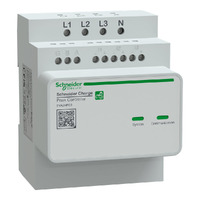
EVA2HPC1 | Schneider Charge | 1 Phase | Anti-tripping | Universal Peak Controller
$403.94
$367.22 ex. GST
Search Results:
Search Results:
Find the best EVlink universal peak controllers here at Sparky Direct. [ Read More ]
The EVlink Universal Peak Controller is a small DIN rail device that watches the total electrical current flowing into a property. When that current rises because other appliances are running, the controller tells a compatible EVlink charging station to lower its charging output. When the household load drops again, the charger can lift its output back up. The result is steady EV charging that respects the limits of the existing supply.
The unit is not a charger by itself. It is an accessory used together with a compatible EVlink Wallbox or other supported EVlink charging hardware. Its job is to coordinate the charger with the rest of the home so the main switch is not pushed past its rating.
EV charging is one of the largest continuous loads in a typical Australian home. A 7.4 kW wall charger pulls around 32 amps on a single-phase circuit, sustained for hours. When the oven, ducted air conditioner, electric hot water, and pool pump all run at the same time, the combined draw can approach the main switch rating.
The peak controller acts before that limit is reached. It reduces EV charging current as other loads ramp up, then releases that headroom back to the charger as those loads drop off. The effect is fewer trip events at the main switch and steadier overnight charging. The device behaves as a proactive load-shedding accessory rather than a reactive protection device.
A circuit breaker is a protection device. It reacts after an overload or fault condition is detected by opening the circuit. A peak controller, by contrast, manages demand on an ongoing basis so the breaker rarely sees an overload in the first place.
The two devices serve different roles and are not interchangeable. The peak controller does not replace correct circuit protection, RCD selection, or compliant electrical design. The licensed electrician must still specify the right protective devices for the EV charger circuit, including an appropriate RCBO or RCD type rated for EV charging applications.
The controller continuously measures the current drawn by the property and compares it against the configured threshold. When household demand approaches that threshold, the controller signals the EVlink charger to reduce its output. When demand falls, the charger is allowed to draw more again. The EV continues to charge at the highest safe rate available under current site conditions.
In practice this means an EV plugged in at 6 pm will charge slowly while the oven and induction cooktop are running. As cooking finishes and the air conditioner cycles down later in the evening, the charger ramps up. Overnight, with most loads idle, the charger runs at or near its maximum rated current. The car is full by morning without anyone needing to coordinate appliance use manually.
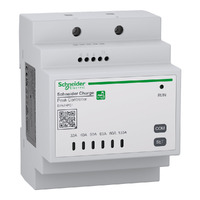
The Universal Peak Controller supports six selectable current thresholds: 16 A, 20 A, 25 A, 32 A, 40 A and 50 A. The chosen setting tells the controller the maximum total current the site is allowed to draw. The setting is not a fixed EV charging speed; it is a site current management limit.
Setting the threshold correctly is the electrician's responsibility. Decision factors include the main switch rating, the assessed maximum demand for the property, the rating of the EV charger, the phase type, the cable route, and the expected mix of household loads. A poorly chosen setting can either limit charging unnecessarily or fail to protect the main switch.
The controller and the EVlink charging station communicate using Power Line Communication, often shortened to PLC. This sends control signals along the existing power conductors, so a separate data cable run between the switchboard and the charger is not required. Installation is simpler where compatible equipment is used.
Electricians should still verify model compatibility, firmware versions, and commissioning steps using current Schneider Electric documentation. PLC depends on the wiring topology between the controller and the charger being within the documented limits.
The EVA1HPC1 is the single-phase Universal Peak Controller. It suits the majority of Australian homes, which are supplied on a single-phase service. Paired with a compatible single-phase EVlink charging station, it manages the household total current against the configured threshold.
Single-phase EV charging commonly supports up to 7.4 kW where the property supply, charger model, and the vehicle's onboard charger all permit it. The peak controller becomes most useful at this charging level, since 32 A of continuous draw on a single-phase board leaves little headroom for the rest of the home during peak times.
The EVA1HPC3 is the three-phase model. It suits larger homes, new builds with three-phase supply, workshops, strata car parks, and light-commercial sites where the wiring is already three-phase. Each phase is monitored, and charging current is balanced across phases by the compatible charger.
Three-phase supply can support higher EV charging capacity when the vehicle and charger can use it, typically 11 kW or 22 kW depending on the model. Even with that extra headroom, load management remains useful where the property has multiple high-load appliances or future plans to add a second EV.
No. The EVlink Universal Peak Controller is designed for compatible Schneider Electric EVlink charging equipment. It is not a universal load management accessory for every charger brand on the market. Treating it as such will lead to commissioning faults, an inactive communication LED, or no load management behaviour at all.
Compatibility should be confirmed against the specific charger model, phase configuration, current Schneider documentation, and the installation environment before purchase. Where a different charger ecosystem is in use, such as Ohme EV Chargers, the manufacturer's own load management options should be reviewed instead.
A peak controller becomes essential when the EV charger load may approach or exceed the available supply capacity during normal household operation. Common triggers include an older home with limited switchboard capacity, a single-phase supply with a busy main switch, and a property with electric cooking plus ducted air conditioning. Another trigger is a 7.4 kW charger being added without any upgrade to the network supply.
In these situations, unmanaged charging will eventually trip the main switch or a feeder breaker, often overnight. The peak controller avoids that by reducing EV charging current when other loads are active, then restoring it later. Without the controller, the homeowner is left manually choosing between charging the car and running normal appliances at the same time.
Beyond clear-cut overload risk, a peak controller is strongly recommended where future electrical growth is likely. Heat pumps, pool equipment, solar batteries, induction cooking, home office loads, and a second EV all add to the maximum demand of the site. Adding load management at the same time as the first EV charger creates headroom for those upgrades without a separate supply upgrade later.
It also reduces the chance of future nuisance tripping as the household electrifies. Trade buyers planning EV-ready new builds often specify the peak controller alongside the charger and circuit protection in one project package.
A peak controller may be optional where the licensed electrician confirms ample supply capacity, low concurrent loads, and a charger configured at a fixed current that already keeps demand within safe limits. A three-phase supply on a small household with modest appliance loads is a common example.
The decision is site-specific. Maximum demand calculations, the main switch rating, and the customer's appliance mix all feed into it. A peak controller adds resilience even where it is not strictly required.
Installation must be carried out by a licensed electrician. The peak controller is fixed switchboard wiring and is not a plug-in accessory. Before quoting, the electrician should confirm the supply type, switchboard condition, spare DIN rail capacity, existing circuit protection, charger compatibility, and the maximum demand of the property.
Work must comply with AS/NZS 3000 Wiring Rules and the relevant state or territory electrical safety requirements. The EV charger circuit itself must be protected by an appropriate device, often a Type B RCD or a Type A RCBO depending on the charger's internal DC fault detection. The peak controller does not change those obligations; it sits alongside them in the electric switchboard.
The Universal Peak Controller is designed for indoor DIN rail mounting inside a protected electrical enclosure. Its compact footprint, around 72 mm by 89 mm by 75 mm, fits in standard residential and light-commercial boards. The unit weighs roughly 180 g and adds minimal load to the rail.
The controller is not intended for exposed outdoor mounting. Where the EV charger itself sits outside, the controller stays inside the main board and communicates with the charger over the power line. This keeps the controller protected from weather and within the rated operating environment.
The unit draws around 5 W in normal operation. Its operating temperature range is -30 degrees C to 50 degrees C, with a storage tolerance of -40 degrees C to 85 degrees C. These limits cover the indoor switchboard temperatures seen across most Australian climate zones, from cold mountain regions to hot regional sites.
Low self-consumption matters in a switchboard already busy with smart meters, communication gateways, and other accessories. The published temperature range also supports use in light-commercial sites where the enclosure can warm up during summer trading hours.
Relevant product standards include EN 61010-1 for safety of measurement, control, and laboratory electrical equipment, and EN 61326-1 for electromagnetic compatibility in those applications. Compliance with these standards supports safe use of the controller in measurement and control contexts, which is exactly the role it plays inside a residential switchboard.
Australian installations still need to comply with AS/NZS 3000 and applicable local electrical safety legislation. Product compliance does not remove the need for compliant installation design, correct circuit protection selection, and proper commissioning. The product standards describe what the device is; the installation standards describe how it must be used.
Front-panel LEDs give electricians and users a quick read on controller status without specialist diagnostic software. A red LED indicates a fault or default condition that needs attention. A green LED indicates active control: the controller is reading site current and managing the charger as configured.
A second green communication LED indicates active Power Line Communication with the paired EVlink charger. If the communication LED is not active, the controller is not coordinating with the charger, regardless of what the main status LED shows. Together the LEDs give a fast field check that the peak controller is doing its job.
A licensed electrician should confirm the supply type matches the controller model. The EVlink charger paired with the controller must be on the compatible list, and the configured current threshold must match the design intent. The communication LED should be active after power-up. CT placement and orientation should be checked against the documented arrangement.
This is a high-level commissioning checklist, not a step-by-step electrical guide. Each site has its own switchboard layout, supply arrangement, and charger model. The Schneider Electric installation instructions for the specific controller and charger pairing are the authoritative source.
Several symptoms warrant a licensed electrician's attention rather than DIY investigation. No LED activity at all suggests no supply at the controller. A red LED that stays on indicates a fault that the unit cannot self-clear. A communication LED that remains inactive points to a PLC issue, compatibility mismatch, or commissioning step missed.
If charging still causes nuisance trips after a controller is installed, the maximum demand assessment, current threshold setting, and overall switchboard design all need review. The cause may sit outside the controller itself. In all of these cases the homeowner should call the original installer or another licensed electrician rather than open the switchboard.
Unmanaged EV charging can stop unexpectedly when a breaker trips during the night. The homeowner wakes up to a half-charged car and no obvious cause. A peak controller reduces the chance of that happening by trimming charging current during demand peaks rather than letting the main switch take the hit.
The household does not need to remember to delay the dishwasher or the dryer. The controller manages the negotiation between the charger and the rest of the home automatically. For most owners, the practical benefit is simply a full battery every morning.
A network supply upgrade can run into thousands of dollars and weeks of waiting time. Where the existing supply has enough headroom most of the time, load management can make better use of that capacity. The peak controller smooths peaks rather than chasing the absolute peak, so the same service can support EV charging plus normal loads.
This is not a substitute for proper electrical assessment. Some homes do need a service or switchboard upgrade before an EV charger can be installed safely. The controller helps where the supply is borderline, not where it is genuinely too small.
Load management fits naturally inside a broader home energy strategy. Rooftop solar, battery storage, off-peak tariff programs, and time-of-use rates all reward households that can shape when and how they draw power. Peak demand control by the EVlink controller dovetails with that approach.
The controller itself is not a full solar or battery optimiser. Where solar self-consumption optimisation is needed, that capability usually sits with the compatible charger, an inverter feature, or a separate energy management system. The peak controller's job is to protect the main switch and to coordinate the charger with the rest of the house in real time.
A documented Schneider Electric load management accessory simplifies EV charger quoting on residential projects. The product datasheet, current thresholds, and PLC behaviour are all in the public installation literature, so design work can be referenced rather than improvised.
Power Line Communication reduces the need for a separate control cable between the switchboard and the EV charger where compatible equipment is used. That saves time on site and avoids extra conduit runs. Clear compatibility documentation also supports professional recommendations to homeowners who ask whether they really need it.
The Universal Peak Controller fits cleanly into single homes, duplexes, townhouses, strata car parks, small commercial sites, and developer-specified EV-ready infrastructure. In each of these settings, controlling the maximum demand is important when multiple EV charging points may be added over time.
In strata projects, the controller helps each EV charger sit within the metered capacity of the connected unit. In light-commercial sites, it allows EV charging to coexist with workshop tools, office air conditioning, and other variable loads. Developers benefit because the building is delivered EV-ready without committing to a network upgrade up front.
Single-phase and three-phase versions are ordered separately, so the right model must be selected against the site supply. Stock should be checked before quoting on large jobs. Bundling makes sense: a compatible EVlink charger, an appropriate B EV Type Acti9 iID RCD or RCBO, an isolator, an enclosure, cable, glands, and labels can all be on one order.
Sparky Direct supports trade ordering, bulk project requirements, and delivery planning. Pricing on full project orders is generally better than buying piece by piece across multiple suppliers.
Most EV chargers can be dialled down to a fixed lower current at commissioning. This avoids tripping by simply never letting the charger draw more than a safe level, no matter what the rest of the home is doing. The downside is that the car charges slowly all the time, even at 3 am when the rest of the house is idle.
A peak controller allows the charger to push up to its maximum when site load is low, and trims it only when other appliances run. Average charging speed is higher across the night, with the same protection against overload. Where fast top-ups matter, this is a meaningful improvement over a flat current cap.
Standalone energy management systems and smart-home platforms can also throttle an EV charger using their own logic. These tend to require additional sensors, gateway hardware, and sometimes a paid subscription. They can integrate solar self-consumption, time-of-use scheduling, and multiple loads in one place.
The trade-off is integration complexity. Compatibility between a third-party controller and a specific charger is not always guaranteed, and support sits across two vendors. The EVlink Universal Peak Controller is purpose-built for Schneider Electric EVlink chargers and behaves as a single supported product. Where the EV charger is already in the EVlink range, the Schneider accessory is usually the simpler choice. Where the property already runs a broader energy management platform, that platform may handle the charger directly.
| Feature | EVlink Universal Peak Controller | Third-Party Energy Management System |
|---|---|---|
| Compatible charger ecosystem | Schneider Electric EVlink range | Varies by vendor and integration |
| Phase options | Single-phase (EVA1HPC1), three-phase (EVA1HPC3) | Depends on system and CTs supplied |
| Dynamic load control | Yes, real-time threshold-based | Yes, often with additional rules |
| Communication method | Power Line Communication | Wi-Fi, Ethernet, or vendor protocol |
| Installation complexity | Low, no separate data cable | Higher, gateway and sensors required |
| Best suited to | EVlink charger installs needing load management | Whole-home energy optimisation projects |
| Limitations | Schneider EVlink ecosystem only | Multi-vendor support complexity |
Value depends on the site. On a home where the main switch is already tight and a 7.4 kW EV charger is being added, the controller pays for itself quickly. Fewer nuisance trips, less owner frustration, and the avoided cost of a service upgrade all add up. The peak controller is one of the cheaper line items in an EV install when set against those alternatives.
On a home with generous supply, low concurrent loads, and a small EV onboard charger, the savings are less obvious. Even there, the controller adds resilience against future appliance additions. Whether the value case is strong is best answered by the electrician quoting the job, not by a generic recommendation.
Price varies by model: single-phase and three-phase units sit at different price points, and stock position can shift with project demand and freight cycles. Comparing models on price alone is risky if the wrong phase is chosen, so the correct version for the site supply should be confirmed first.
Trade buyers should confirm stock before committing to project timelines, especially on multi-site rollouts. Sparky Direct can hold trade orders against confirmed stock so installers are not waiting on backorder.
Online ordering works well for this product because it is a known SKU with a clear model reference. Buyers should check that the listed model matches the supply they have (single-phase EVA1HPC1 or three-phase EVA1HPC3), that the unit is supplied for the Australian market, and that warranty support is available locally. Invoice documentation is important for trade compliance and warranty claims.
Delivery requirements depend on project timing. For metro Australian addresses, dispatch is generally next-day. Bundling the controller with the compatible Schneider Charge charger and required circuit protection reduces the number of separate deliveries on site.
Club Clipsal is Australia's largest electrician community offering trade rewards, business support, and exclusive benefits. When you nominate Sparky Direct as your preferred wholesaler, we automatically apply your Clipsal spend points to your Club Clipsal account daily.
Entry-level offering coaching, mentoring, and training discounts
Unlock exclusive industry tools and networking events
Access Toyota fleet offers and business software discounts
Maximum benefits, including VIP experiences and rewards
1. Sign Up: Create your Club Clipsal account at clipsal.com/club-clipsal or via the iCat mobile app
2. Nominate Sparky Direct: Select Sparky Direct from the wholesaler dropdown menu in your profile
3. Add Email: Enter your Sparky Direct account email address in the membership number field
4. Start Earning: Every dollar spent on Clipsal products earns points automatically
Redeem points from the rewards store, including gift cards, tools, and experiences. Access business summits, product training, and industry networking events. Receive early access to new product launches and special promotions. Connect with fellow electricians via the Club Clipsal community app.
Watch Clipsal MX9MS1100 | MAX9 Main Switch 1P 100A video
Watch SUNGROW S100 | Single Phase Smart Energy Meter 100 Amp video
Watch Tesla ADM100SC | 1 Phase 100Amp Kilowatt Hour Meter DIN Rail | Digital video

This type A breaker was exactly what I was after for my EV charger and it works perfectly. Installation was quick and easy and compliments my other breakers on my switchboard.
Bought for our 7.4Kw EV charger. Fast shipping, easy to deal with. Our electrician had no problem installing and we used it that night. Solid.
Happy with the quality of this NLS branded 3-phase outlet. Price was excellent also. Using it for a plug in 3-phase ev charger.
Quality products in stock • Fast Australia-wide delivery • Competitive trade pricing
Browse EVlink Universal Peak Controllers → Get Expert Advice →