
Search Results:
Search Results:
Search Results:
Search Results:
Contactor accessories are add-on components used with standard electrical contactors. These include auxiliary contact blocks, coil suppressors, surge suppressors, mechanical interlocks, timer modules, links, wiring kits, coils, and mounting accessories. Electricians select accessories to suit the contactor brand, series, frame size, control voltage, and specific application. Cross-brand compatibility should not be assumed. Accessories are matched to the exact contactor model and installed in accordance with manufacturer datasheets and Australian wiring requirements.
Contactors are sold as base devices with a fixed coil voltage and pole configuration. Accessories let the same base contactor adapt to different control schemes without changing the main device. A 25A two-pole contactor can serve a hot water timer circuit, a pump duty-share circuit, or a reversing fan circuit depending on which accessories are fitted. Specifying accessories separately also reduces stock complexity for wholesalers and panel builders, since one contactor frame covers many end applications.
Australian installations reference AS/NZS 3000 for wiring, AS/NZS 60947 for low-voltage switchgear and controlgear, and IEC 60947-4-1 specifically for contactors and motor-starters. Manufacturer datasheets list the specific accessories tested and certified with each contactor range. Accessories that are not listed in the manufacturer datasheet for a given contactor must not be assumed compatible, even if they appear to fit physically.
The contactor switches the load while accessories support signalling, interlocking, timing, suppression, and connection functions. Accessories may mount to the front, side, top, coil terminals, or DIN rail depending on the part type and contactor model. An auxiliary contact provides run feedback to a BMS or PLC. A suppressor protects a PLC output from back-EMF when the coil de-energises. A mechanical interlock prevents two modular contactors from closing together in a reversing motor starter.
Auxiliary contacts give the control system visibility of contactor state. A NO auxiliary closes when the main contacts close, so a PLC, BMS, or indicator lamp sees the run state directly. NC auxiliaries open under the same condition and feed stop permissive logic or interlocking. This separation between power switching and signalling keeps high-load current away from control wiring, which is essential for reliable PLC inputs and clean indication circuits.
Coil suppressors sit across the A1 and A2 terminals to absorb the voltage spike produced when the coil collapses. This protects whatever drove the coil, typically a PLC output, a smart relay output, or a small interface relay. Surge protection at the panel level is separate work, but coil suppression is a per-contactor accessory installed at the contactor itself.
Mechanical accessories include interlock kits, link sets, and mounting plates. Interlocks physically prevent two contactors from closing together, which matters in reversing motor circuits and changeover assemblies. Link sets pre-form the busbar connections between paired contactors in reversing or star-delta sets. These mechanical accessories reduce wiring time and make commissioning more predictable.
The most common accessories contractors order include auxiliary contacts, coil suppressors, mechanical interlocks, timer modules, wiring links, replacement coils, terminal covers, mounting kits, and interface relays. Auxiliary contacts are most relevant for motor starters, BMS panels, HVAC control, and lighting control where status feedback or control interlocking is required. Coil suppressors are specified for PLC-controlled panels and automation switchboards. Mechanical interlocks are used in reversing circuits, changeover assemblies, and star-delta motor starters. Timer modules suit sequencing applications, delayed start functions, and ventilation run-on circuits.
Electrical accessories influence the control circuit directly. Auxiliary contact blocks add NO or NC contacts to the contactor for signalling and interlocking. Coil suppressors absorb back-EMF to protect upstream control electronics. Replacement coils suit field service when a coil fails but the contactor body is sound. These three accessory types account for most service and stocking activity on common contactor ranges.
Mechanical accessories influence the physical assembly and safety of the contactor installation. Interlock kits, link sets, terminal covers, and mounting kits each have a specific purpose. Terminal covers improve IP rating around the connection terminals. Mounting kits adapt contactors to panel layouts where DIN rail width is constrained. These accessories often ship as part of motor starter or reversing assembly packs.
Functional modules add control intelligence to the contactor circuit. DIN rail timers provide on-delay, off-delay, and star-delta transition functions. Interface relays bridge between low-voltage PLC outputs and 240Vac contactor coils. Manufacturer-specific add-on modules can add features like programmable timing or communication interfaces to compatible contactor ranges. Module selection is driven by control circuit voltage, timing requirement, and brand compatibility.
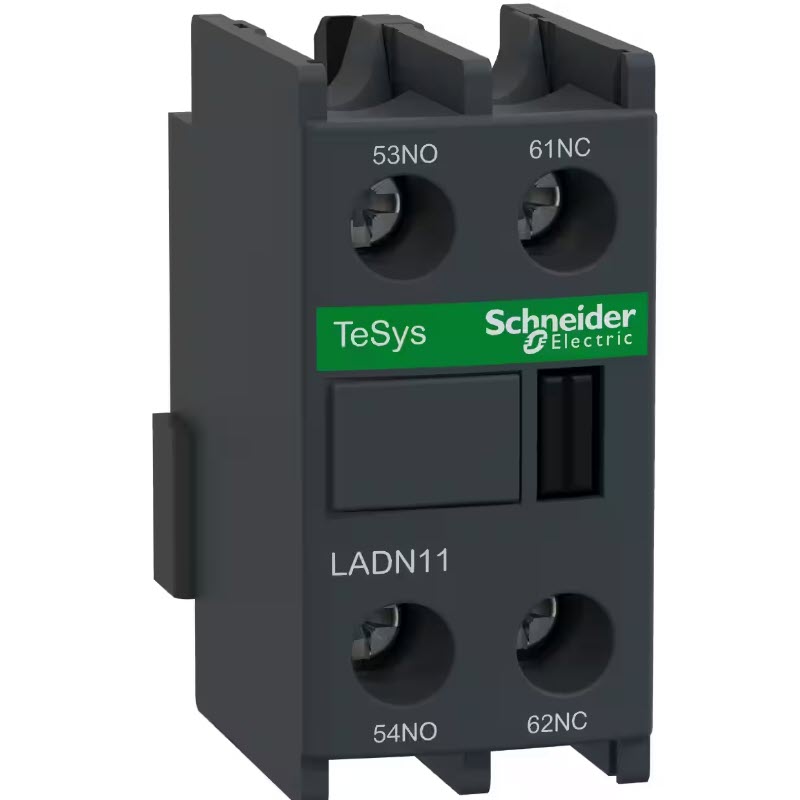
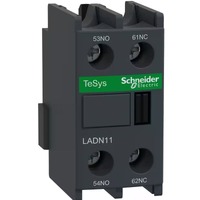
Auxiliary contacts are the most common accessory type for contactors. They provide status indication, control logic, BMS and PLC inputs, latching circuits, and electrical interlocking. Typical configurations include 1 NO (normally open), 1 NC (normally closed), or combinations such as 2 NO, 1 NO + 1 NC, or 4 NO. The auxiliary block must match the exact contactor range and model. Panel builders use auxiliary contacts for run indication lamps, fault signalling, control enable circuits, and electrical interlocking between contactors.
Normally open auxiliary contacts close when the contactor energises. Normally closed auxiliary contacts open when the contactor energises. In Australian trade language, NO contacts are used for run indication, PLC feedback, fan proving signals, and control enable circuits. NC contacts are used for electrical interlocks, stop permissive circuits, and control lockout functions. Contact ratings typically range from 3A to 10A for control circuits at 240Vac or 24Vdc. Electricians check datasheets to confirm current ratings and contact configuration before ordering auxiliary blocks.
NO contacts close when the contactor energises. They are commonly used for run lamps, PLC feedback signals, and fan proving circuits. NC contacts open when the contactor energises. They are used for electrical interlocks, stop permissive logic, and control lockout functions. A NO contact on a motor contactor can signal a PLC that the motor is running. An NC contact from a second contactor can prevent the first contactor from closing again until the second has fully released.
Mounting position depends on the contactor model, available switchboard space, wiring access requirements, and the number of auxiliary contacts needed. Front-mounted blocks are common on smaller DIN rail contactors. Side-mounted blocks suit larger frame contactors where panel width is limited. Top-mounted blocks provide good access for control wiring on compact assemblies. Cross-brand compatibility should not be assumed. Electricians must verify the mounting type and contact configuration when specifying replacements.
Coil suppression is important where contactors are controlled by PLCs, BMS outputs, relays, timers, or smart controllers. When a contactor coil de-energises, the collapsing magnetic field generates a voltage spike (back-EMF) that can damage sensitive control electronics. Coil suppressors absorb or limit these spikes. Suppressor choice depends on whether the coil is AC or DC and the control voltage. Installing the wrong suppressor type can result in poor protection or failure. Licensed electricians specify suppressors based on coil type, control circuit voltage, and manufacturer recommendations.
A coil suppressor is a device connected across a contactor coil to absorb or limit voltage spikes when the coil de-energises. Common types include MOV (metal oxide varistor), RC snubber, and diode modules. A varistor or MOV is common for AC control circuits. An RC snubber is useful for AC transient suppression. A diode module is used for DC coils, especially in PLC-controlled circuits. Selecting the wrong suppressor type can cause poor protection, component failure, or nuisance faults.
Varistor or MOV suppressors are common for AC control circuits and clamp voltage spikes above the rated voltage. RC snubbers use a resistor-capacitor network for AC transient suppression and suit circuits with repeated switching. Diode modules are used for DC coils and are common in PLC-controlled automation panels where the PLC output cannot tolerate back-EMF. Electricians check the coil voltage, control circuit type (AC or DC), and manufacturer compatibility before selecting a suppressor.
Coil suppression is most important in installations with PLC outputs, automation panels, BMS controls, VSD-adjacent panels, long control wiring runs, and applications with repeated switching cycles. The practical benefit is reduced nuisance faults, longer control component life, and better panel reliability. Suppressors are standard practice in industrial automation and building services control, where the cost of a control failure far exceeds the cost of the suppressor.
Interlocks and links support safer, more reliable control circuits in reversing starters, star-delta starters, changeover circuits, and control circuit simplification. Mechanical interlocks physically prevent two contactors from closing simultaneously. Electrical interlocks use NC auxiliary contacts to prevent conflicting contactor operation. Wiring links and connection sets reduce loose wiring, improve termination consistency, and make panels neater. Safety-critical motor and switchboard work requires licensed electrical design and installation in accordance with AS/NZS 3000.
Mechanical interlocks physically prevent two contactors from closing at the same time. They are used in reversing motors, changeover arrangements, and star-delta assemblies. The interlock kit must match the contactor frame size and series. Model-specific selection is required because mounting holes, frame dimensions, and interlock mechanisms vary between contactor brands and ranges. Licensed electricians verify mechanical interlock compatibility before ordering or installing these accessories.
Electrical interlocking uses NC auxiliary contacts to prevent conflicting contactor operation. An NC contact from contactor A is wired in series with the coil circuit of contactor B. Contactor B cannot close while contactor A is energised. Best practice in higher-risk control assemblies often combines electrical and mechanical interlocking for redundancy. Electrical interlocking alone suits lower-risk applications where physical contact prevention is not required by the design or compliance standard.
Contactor links, wiring kits, and connection sets reduce loose wiring, improve termination consistency, and make panels neater. Applications include reversing sets, star-delta sets, motor starter assemblies, and accessory packs. Links are pre-formed copper or insulated bars that connect contactors in standard configurations. Using links reduces installation time, improves wiring reliability, and makes fault finding easier during commissioning and maintenance.
Timer accessories are used with contactors for delayed start, delayed stop, duty cycling, sequencing, and star-delta transition functions. Timers can be separate DIN rail relays or manufacturer-specific add-on modules. Electricians specifying motor starters, HVAC controls, ventilation systems, pumps, and staged loads use timers to sequence equipment, reduce starting current, or provide run-on functions. Timer selection depends on control voltage, timing function, timing range, contact rating, DIN rail compatibility, LED status indication, and brand compatibility.
Selection criteria for contactor timers include control voltage (240Vac or 24Vdc), timing function (on-delay, off-delay, star-delta), and timing range (seconds to hours). Other factors include contact rating sufficient for the contactor coil load, DIN rail compatibility, LED status indication for commissioning and fault finding, and brand compatibility with existing panel components. No single universal product suits all applications. Licensed electricians select timers based on the specific application, control voltage, and timing requirements of the load being controlled.
On-delay timers energise the output after a set delay period. Off-delay timers de-energise the output after a set delay period. Star-delta timers control the transition from star to delta connection in suitable three-phase motor applications to reduce starting current. Timer settings are application-dependent and must be determined by a licensed electrician or designer based on motor characteristics, load type, and switching sequence requirements. Star-delta starting is not suitable for all motors and must be checked against motor nameplate data.
Practical commercial applications for timer modules include fan run-on, where ventilation continues after occupancy, and pump sequencing, where alternating pumps reduce wear. Other applications include staged loads to reduce starting current on multiple motors, lighting delay circuits where safety lighting remains on for a set period, and ventilation purge cycles for timed extraction. Contractors need reliable, serviceable DIN rail control components that are widely supported and have readily available replacement parts.
Accessories must match the contactor brand, series, frame size, coil voltage, and mounting configuration. Cross-brand compatibility should not be assumed. A Clipsal auxiliary block will not fit a Siemens contactor. An ABB suppressor may not suit a Hager coil. Even within the same brand, different contactor ranges use different accessory part numbers. Electricians must verify compatibility by checking manufacturer datasheets, part number cross-references, and technical specifications before ordering accessories.
Compatibility Check: Always verify the contactor brand, series, and frame size before ordering accessories. Incorrect accessories will not fit or may cause unsafe operation. Consult manufacturer datasheets and technical support if unsure.
Different contactor brands and series have different mounting dimensions, terminal layouts, coil configurations, and accessory fitment. Schneider TeSys D contactors use different auxiliary blocks than TeSys LC1 contactors even though both are Schneider products. Electricians must identify the exact contactor model number and series before selecting accessories. Manufacturer catalogues and online datasheets provide accessory compatibility tables and part number cross-references.
Contactor frame size determines which accessories will physically fit. Frame sizes are typically denoted by numbers (00, 0, 1, 2, 3, 4) or letters (A, B, C, D) depending on the manufacturer. Larger frames accept more auxiliary contacts and have different mounting holes. Electricians check the frame size marked on the existing contactor and match accessories accordingly. DIN rail mounting width also affects accessory selection in compact switchboards where space is limited.
Coil voltage must match the control circuit supply. Common voltages include 240Vac, 110Vac, 24Vac, and 24Vdc. A contactor with a 240Vac coil requires accessories rated for 240Vac control circuits. DC coils require DC-compatible suppressors, typically diode modules. AC coils require AC-compatible suppressors, typically varistors or RC snubbers. Installing the wrong voltage accessory can result in failure, poor operation, or safety hazards. Electricians verify coil voltage from the contactor nameplate before ordering.
Installation and wiring of contactor accessories must be completed by a licensed electrician in accordance with AS/NZS 3000, manufacturer instructions, and switchboard design documentation. Accessories must be mounted securely, wired correctly, and tested before the switchboard is energised. Incorrect installation can cause control circuit faults, nuisance tripping, equipment damage, or safety hazards. Electricians must isolate circuits and confirm dead before commencing work on switchboards, motor starters, or control panels.
Auxiliary contacts and suppressor modules mount to the contactor body according to the manufacturer instructions. Front, side, or top mounting depends on the contactor model and accessory type. Mounting screws must be tightened to the torque specified in the datasheet. Loose mounting can cause poor contact operation, vibration noise, or accessory detachment during transport or operation. Electricians must verify secure mounting before proceeding to wiring.
Auxiliary contacts are wired into control circuits according to the switchboard schematic. NO contacts are wired in parallel for indication or in series for permissive logic. NC contacts are wired in series for interlocking. Wire sizing, terminal tightness, and labelling must comply with AS/NZS 3000 and the switchboard design. Electricians must verify correct contact operation by simulating the switching sequence before energising the load circuit.
Coil suppressors are connected directly across the contactor coil terminals (A1 and A2). Polarity matters for DC suppressors such as diode modules, but not for AC suppressors such as varistors or RC snubbers. Wiring must be short and direct to minimise inductance. Electricians must verify suppressor polarity and connection before energising the control circuit. Incorrect polarity on a DC suppressor will result in no suppression and possible PLC output damage.
Best value is determined by correct fit, compliance with Australian standards, and availability of replacement parts. Choosing the cheapest accessory that does not fit or fails prematurely is not value. Licensed electricians prioritise compatibility, manufacturer reputation, datasheet confirmation, and supplier stock availability. Accessories from reputable brands with good Australian support networks reduce the risk of obsolescence, warranty issues, and failed commissioning.
Bundled solutions for motor starters, reversing sets, and maintenance stock can reduce cost and simplify ordering. Accessory packs typically include auxiliary contacts, coil suppressors, terminal covers, and wiring links matched to a specific contactor range. Contractors and maintenance teams benefit from keeping common accessory packs in stock for fast service response. Electricians should verify that pack contents suit the specific application and contactor model before ordering.
Value and deal-related searches are common for contractors managing project budgets. Affordable options exist but must not compromise safety, compatibility, or compliance. Licensed electricians verify that accessories meet Australian requirements and match the exact contactor model. Reputable Australian suppliers stock accessories from Legrand, Clipsal, Hager, and Siemens with fast delivery and technical support. Purchasing from non-compliant or unsupported sources increases the risk of project delays and failed inspections.
Contractors, maintenance teams, and panel builders ordering repeated part numbers benefit from bulk pricing and stock availability. Suppliers with good trade pricing, account terms, and reliable delivery support project schedules and maintenance programs. Electricians should establish accounts with suppliers who stock the specific contactor brands and accessories used in their projects and service work.
Online ordering requires accurate part matching to avoid wrong-part deliveries, project delays, and return costs. Electricians must verify the contactor brand, series, frame size, coil voltage, and accessory type before placing orders. Product images alone are not sufficient for accurate part identification. Datasheets, part numbers, and technical specifications must be checked. Reputable online electrical wholesalers provide detailed product information, technical datasheets, and customer support to assist with part matching and compatibility verification.
Comparison between suppliers should consider product range, stock availability, technical support, delivery speed, pricing, and compliance documentation. Sparky Direct stocks accessories from major brands with fast Australia-wide delivery and trade pricing. Technical support is available to assist with part matching and compatibility questions. Online ordering with secure payment and account terms supports project budgets and maintenance schedules.
Review-based searches are common, but technical suitability must be grounded in datasheets, not just reviews. A five-star review for an accessory that does not fit your contactor is not useful. Electricians should prioritise manufacturer datasheets, compatibility tables, and technical specifications over generic reviews. Supplier signals such as stock availability, delivery time, and return policy are more relevant than product reviews when ordering accessories for specific contactor models.
Maintenance planning includes regular inspection, fault finding procedures, and stocking common replacement parts. Auxiliary contacts can wear or fail in high-cycle applications. Coil suppressors can fail open or short. Mechanical interlocks can wear or seize. Licensed electricians inspect accessories during scheduled maintenance and replace worn or failed parts before they cause equipment downtime or safety hazards.
Electricians and contractors managing common service parts should stock auxiliary blocks, coil suppressors, and replacement coils for the contactor brands and models they service regularly. Spares kits reduce service response time and avoid project delays waiting for parts. Common spares include 1 NO and 1 NC auxiliary blocks, varistor suppressors, and standard coil voltages (240Vac, 24Vdc) for frequently used contactor ranges.
Generic wiring diagrams can be unsafe or incorrect if they do not match the exact contactor model and accessory type. Terminal layouts, coil polarity, auxiliary contact configurations, and suppressor connections vary between brands and ranges. Licensed electricians must refer to the manufacturer datasheet and switchboard schematic for the specific contactor and accessories installed. Generic diagrams found online or in service manuals may not apply to the specific equipment and should not be used without verification.
Watch Schneider Electric TeSys LC1D09U7 D Contactor 9A AC-3 240Vac Coil video
Watch Tesla TESHWP Hot Water Contactor and Timer Pack 25A video
Watch ANDELI CJX2N-12-U7 Contactor 12Amp AC3 240V coil video

The Schneider Electric LC1D09U7 contactor has proven reliable for switching a 1.5 kW, 3-phase motor integrated with WiFi automation circuitry. Its robust, well-made design and dependable performance make it ideal for various industrial and automation applications.
Easy to instal and set, a basic alternative to a solar diverter and 1/10th of the cost. Based on the overnight usage data for my hot water cylinder this will pay for itself within a few months, a diverter would’ve taken years!
contactor works really well for our application (woodworking bandsaw with 1hp / 750W single phase AC motor). Excellent service & delivery etc., from SparkyDirect. All good!
Quality products in stock • Fast Australia-wide delivery • Competitive trade pricing
Shop Contactor Accessories → Get Expert Advice →Yes, accessories such as interlocks and surge suppressors help improve operational safety.
Sparky Direct supplies contactor accessories Australia-wide, offering compatible and reliable components with convenient delivery.
Contactor accessories are securely packaged and delivered via standard courier services.
Unused products are generally eligible for return according to the seller’s returns policy.
Warranty coverage varies by manufacturer and typically covers defects in materials or workmanship.
Yes, contactor accessories are typically sold as individual components.
Yes, correct selection ensures compatibility, safety, and reliable operation.
They generally require minimal maintenance when correctly installed.
Yes, they are commonly used in HVAC and building management systems
Yes, they support integration with timers, PLCs, and automation systems.
Quality accessories are built to withstand long-term use in electrical systems.
Yes, auxiliary contacts provide status feedback for control and indication circuits.
They are designed for straightforward installation by licensed professionals.
Contactor accessories are additional components designed to enhance, protect, or expand the functionality of electrical contactors.
Yes, they are frequently used in control panels and switchboard installations.
They allow contactors to be adapted to specific applications and control requirements.
Some accessories can be added to existing contactors, depending on compatibility.
Yes, many accessories are designed for DIN rail–mounted contactors.
Yes, when correctly selected, they enhance performance, protection, and control capability.
Yes, they are commonly used in commercial switchboards and control systems.
Yes, they are widely used in industrial control panels and machinery systems.
Many accessories are designed for specific contactor models or brands and should be matched correctly.
Quality contactor accessories are manufactured to meet relevant AS/NZS electrical and safety standards when used as intended.
They are used to improve control, safety, indication, and system integration of contactors.
Common accessories include auxiliary contacts, surge suppressors, interlocks, mounting kits, and mechanical latches.